How Many Hours per Month? Using 24-Hour Days
Learn how many hours per month there are using 24-hour days: 672, 696, 720 or 744. Multiply calendar days by 24 and check February.
On this page
Okay, I know you’re probably wondering: how many hours are there in a month?
How many hours per month
Well, if we count the number of days in the calendar month and multiply that by the number of hours in a day (which is 24), then we can compute the nominal hours for that particular month. This approach gives us an idea of the total hours available to each month. The table below shows this calculation.
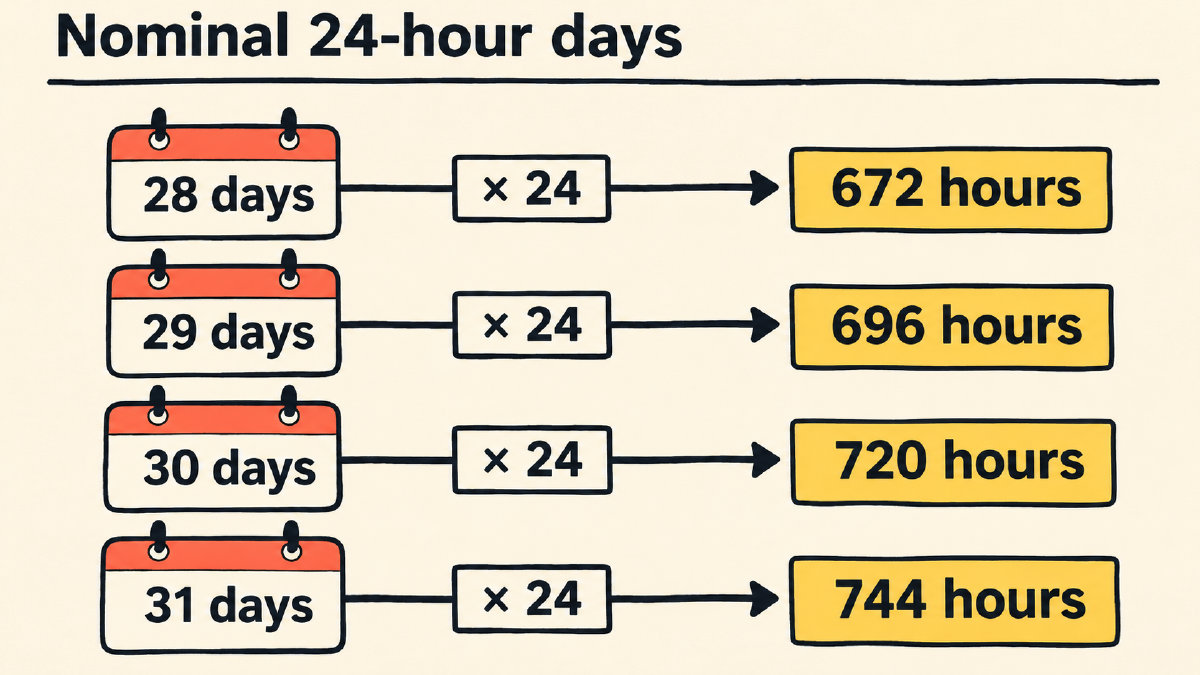
| Days in the month | Calculation | Hours |
|---|---|---|
| 28 | 28 × 24 | 672 |
| 29 | 29 × 24 | 696 |
| 30 | 30 × 24 | 720 |
| 31 | 31 × 24 | 744 |
That gives us a range of possible hours from 672 to 744, depending on how many days a month has. So, which applies to which month?
Here’s the breakdown:
There are seven months with 31 days: January, March, May, July, August, October, and December. These months have 744 hours each.
Four months have 30 days: April, June, September, and November. Each of these has 720 hours.
February is the odd one out, since it typically has 28 days, but it can also have 29 days. In an ordinary year, February will have 28 days (672 hours) in a non-leap year, but in a leap year, it’ll have 29 days (696 hours). As such, when choosing which number to use, it all comes down to the year itself and whether or not it is a leap year.
Leap years
The Gregorian calendar determines whether or not a year is a leap year. For most years, simply check to see if it is divisible by four; however, century years must be divisible by 400 as well. For example, both 1600 and 2000 were leap years, but so were 2400. On the other hand, neither 1700 nor 1800 nor 1900 nor 2100 were leap years.
In short, if it is divisible by four and not a century year, it is a leap year. If it is a century year, then it must be divisible by 400 to be a leap year.
So, to determine whether a year is a leap year, first see if it’s divisible by four. If it is, then check if it’s a century year (ending in 00). If it is a century year, it’s only a leap year if it’s also divisible by 400. If it isn’t a century year, then it’s a leap year.
Therefore, the total hours in February depend upon whether or not it is a leap year.
In either case, the hours in February will be either 672 or 696.