How to Find Elapsed Time With Clocks on the Same Day
Find elapsed time with clocks: read the hands, count forward across hours, and check a same-day example from 2:45 p.m. to 4:10 p.m.
On this page
Establishing the Start and End Context
Before you can interpret an interval between two times, you need to establish the order in which those events happened. When both the start and end happen on the same day, it is relatively easy: for example, if the clock face displays 2:45 p.m., that’s a known time on the same day as the end time of 4:10 p.m. The hands themselves are not enough to establish that context because a 12-hour analog clock can display identical hand positions in both the a.m. and p.m. In other words, 2:45 could be either 2:45 a.m. or 2:45 p.m.
Reading Both Hands Together
One key to finding elapsed time is reading both hands together. That means that you have to look at each face separately to understand how they connect to a written time. Each hour hand points to a certain hour (e.g., 3), but its position between hours tells you the number of minutes passed within that hour. You can count the minute hand’s position in fives: each number represents five minutes. If the hour hand is between 2 and 3, then the time must be after 2 o’clock but before 3 o’clock. In this case, the minute hand is at the 9, representing 45 minutes past the hour. Similarly, if the minute hand is pointing to the 2, that indicates 10 minutes past the hour. Since the hour hand is between the 4 and the 5, the time must be somewhere after 4:00 but before 5:00.
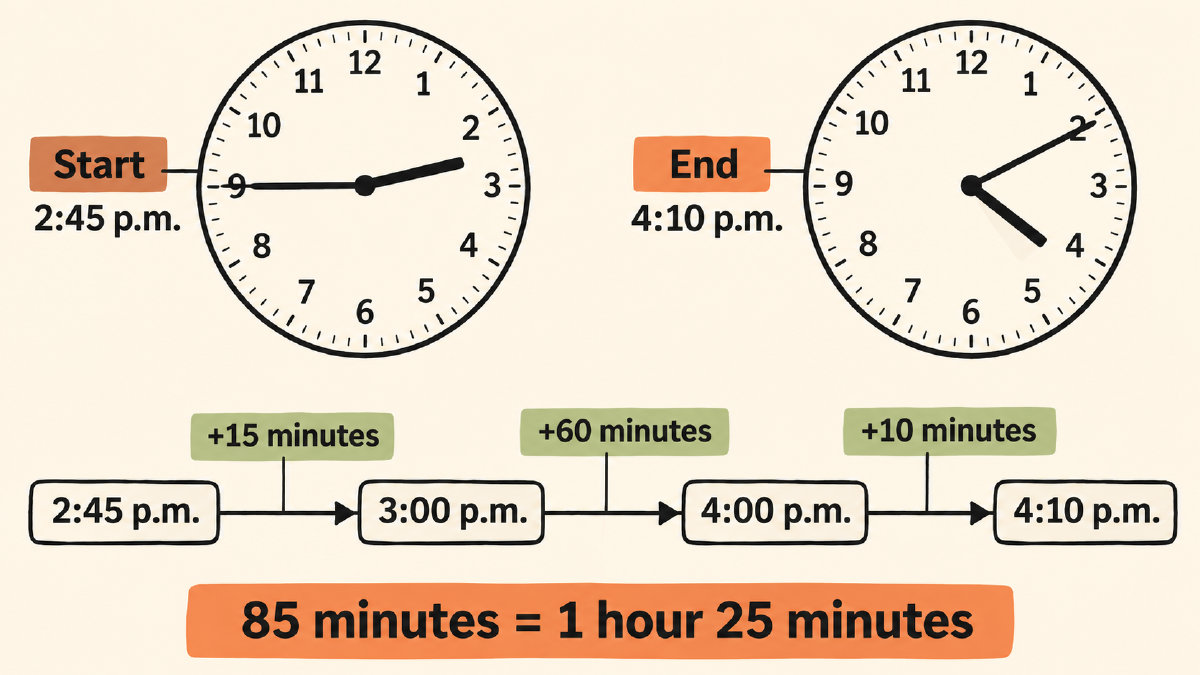
In both instances, you’ll notice that the hands are moving together. This helps distinguish the current hour from the approaching one. For example, in 2:45, the minute hand has passed halfway toward the next hour. The hour hand, meanwhile, is still pointing toward the current hour (in this case, 2) and will point toward the next hour (the 3) once the full hour passes.
You should also note that equivalent digital times appear with different values, depending on whether it’s a.m. or p.m. A digital time of 4:10 appears just like any other time, but if you know the context, you can identify whether it’s a.m. or p.m. In this instance, you already know the start and end were both on the same day, so it’s safe to say that 2:45 was followed by 4:10.
Working Through Forward Jumps
You may find forward jumps across hour boundaries useful. To do this, you need to record each contribution made to the total amount of time. In doing so, you’ll retain complete turns that occur while the clock itself makes a jump.
For example, suppose we take the time from 2:45 p.m. to 4:10 p.m. If you start counting forward, you’ll jump ahead 15 minutes until you arrive at the 3:00 p.m. mark. From there, you’d count 60 minutes, or one hour, to reach 4:00 p.m. Then, simply add another 10 minutes to reach 4:10 p.m.
Now add up the contributions: 15 + 60 + 10 = 85 minutes. That is equal to 1 hour and 25 minutes. Remember, one complete minute-hand turn equals 60 minutes, so that 1 hour would represent a complete turn. Finally, keep track of the ending minute-hand position and the progression of the hour, which is now at 4 instead of 2.
Checking Your Work
To check your answer, simply perform the addition back to the start. If you begin at 2:45 p.m., add 1 hour and 25 minutes, and arrive at 4:10 p.m., then you’ve done everything right.