Printable Elapsed Time Worksheets With Worked Answers
Print original elapsed time worksheets, practice finding duration, start and end times, and check your work with explained answers.
On this page
In this article, you’ll find elapsed time worksheets in three original question tables with answer spaces left blank for the student to complete. A separate section provides the answers to each of these questions.
The practice levels (half-hour, five-minute and one-minute) reflect the needs of different students; they do not represent universal grade requirements. For instance, “half-hour” problems include clock values at whole-hour marks and on half-hour marks, such as 9:00 a.m., 9:30 a.m., 10:00 a.m. and so forth. “Five-minute” problems are similar but only have clocks marked every five minutes (i.e., 9:00 a.m., 9:05 a.m., 9:10 a.m.). One-minute problems are more arbitrary in that minute values are provided without any particular structure.
There are several types of elapsed time problems:
Duration: You’ll see durations missing. This is calculated by counting forward.
Missing end: Start time + duration = end time.
Missing start: End time − duration = start time.
Same-day, 12-hour times. Explicit a.m. and p.m. are included.
Article content for browser printing.
Elapsed Time: Number-Line Relationship
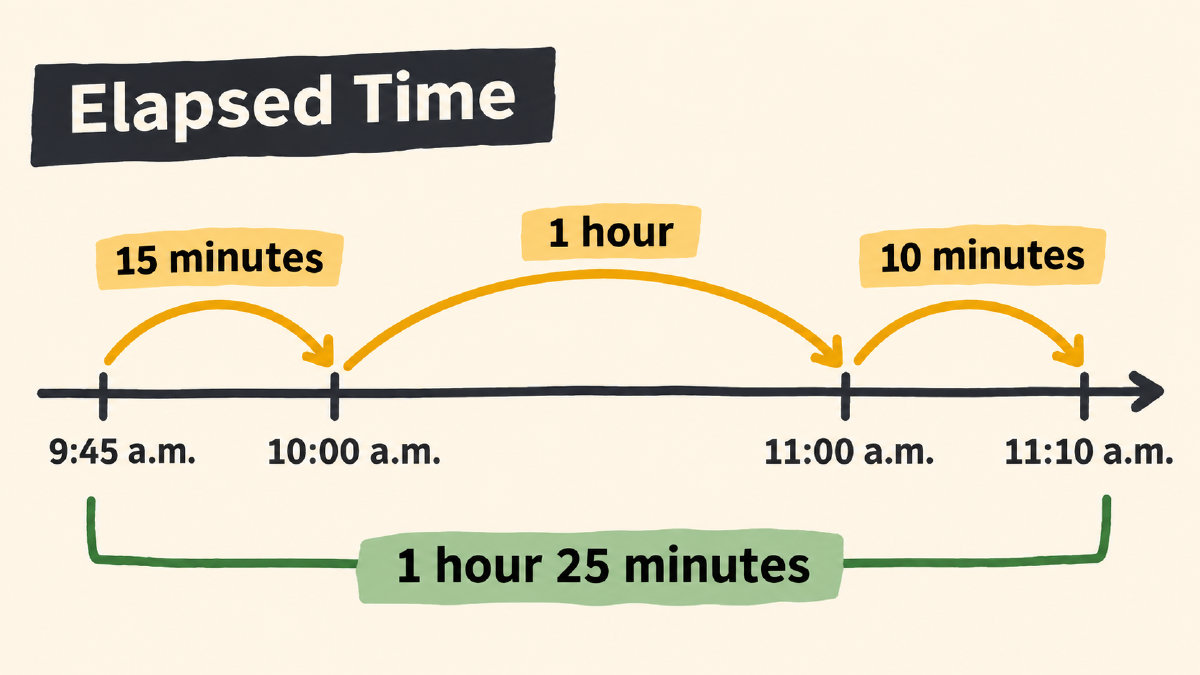
When we talk about elapsed time, the number-line helps us understand how the durations between times can be found by either adding or subtracting.
To find duration, you can count forward. To find an end, add the duration. To find a start, subtract the duration. All of these methods involve moving forward or backward on the timeline. Let’s take a few examples.
Start: 9:45 a.m.
End: 11:10 a.m.
Duration: ?
First, 9:45 a.m. → 10:00 a.m. is 15 minutes.
Second, 10:00 a.m. → 11:00 a.m. is 1 hour.
Third, 11:00 a.m. → 11:10 a.m. is 10 minutes.
Total: 1 hour 25 minutes.
Missing end: Start + duration = end. So 9:45 a.m. + 1 hour 25 minutes = 11:10 a.m.
Missing start: End − duration = start. We can work backwards from the end to the beginning. From 11:10 a.m. to 11:00 a.m. is 10 minutes. From 11:00 a.m. to 10:00 a.m. is 1 hour. Then, 10:00 a.m. back to 9:45 a.m. is 15 minutes.
Backward jumps: The first jump was 10 minutes, then 1 hour, then 15 minutes. If you want to use this method, simply break up the time into manageable segments, then sum them all up.
Half-Hour Elapsed Time Worksheet
This worksheet asks the student to calculate elapsed time when the starting and ending points are both set to the nearest half-hour. There’s a single unknown per row — either the start, end, or duration. The student has space to write down each of their answers.
(H1) Start: 8:00 a.m. End: 9:30 a.m. Duration: ______
(H2) Start: 10:30 a.m. Duration: 1 hour 30 minutes End: ______
(H3) End: 3:00 p.m. Duration: 1 hour 30 minutes Start: ______
Five-Minute Elapsed Time Worksheet
This worksheet also asks the student to calculate elapsed time when the starting and ending points are both set to the nearest five-minute interval. There’s a single unknown per row — either the start, end, or duration. The student has space to write down each of their answers.
(F1) Start: 8:35 a.m. End: 10:10 a.m. Duration: ______
(F2) Start: 11:50 a.m. Duration: 25 minutes End: ______
(F3) End: 4:20 p.m. Duration: 45 minutes Start: ______
One-Minute Elapsed Time Worksheet
Finally, the one-minute worksheet requires precise calculation of the elapsed time when the starting and ending times fall on arbitrary minutes (i.e., 8:17 a.m.). Again, there’s a single unknown per row — either the start, end, or duration. The student has space to write down each of their answers.
(M1) Start: 9:17 a.m. End: 10:43 a.m. Duration: ______
(M2) Start: 11:48 a.m. Duration: 37 minutes End: ______
(M3) End: 3:06 p.m. Duration: 48 minutes Start: ______
Elapsed Time: Answer Key
If your student is working independently, the following answer key can help verify whether they’ve completed the worksheet correctly. Alternatively, it might be easier to check your child’s understanding if you go over the worksheet together, step-by-step.
(H1) 8:00 a.m. → 9:00 a.m. → 9:30 a.m. 1 hour + 30 minutes = 1 hour 30 minutes
(H2) 10:30 a.m. → 11:30 a.m. → 12:00 p.m. +1 hour, +30 minutes
(H3) 3:00 p.m. → 2:00 p.m. → 1:30 p.m. −1 hour, −30 minutes
(F1) 8:35 a.m. → 9:00 a.m. → 10:00 a.m. → 10:10 a.m. 25 + 60 + 10 = 95 minutes = 1 hour 35 minutes
(F2) 11:50 a.m. → 12:00 p.m. → 12:15 p.m. +10 minutes, +15 minutes
(F3) 4:20 p.m. → 4:00 p.m. → 3:35 p.m. −20 minutes, −25 minutes
(M1) 9:17 a.m. → 10:00 a.m. → 10:43 a.m. 43 + 43 = 86 minutes = 1 hour 26 minutes
(M2) 11:48 a.m. → 12:00 p.m. → 12:25 p.m. +12 minutes, +25 minutes
(M3) 3:06 p.m. → 3:00 p.m. → 2:18 p.m. −6 minutes, −42 minutes
Inverse checks should be performed for every answer. For example, let’s say your child determines the duration between 8:00 a.m. and 9:30 a.m. is 1 hour 30 minutes. Check this by seeing whether the start time plus the duration gives the end time. 8:00 a.m. + 1 hour 30 minutes equals 9:30 a.m.
You might also perform an independent check using the site’s existing tool. First, enter the completed start and end times. Then, select “Calculate” and compare the duration with your answer. Your child could also try this out themselves!
Time Duration Calculator
Completed start and end times
12-hour entry
Matching AM/PM values
No break deducted
The calculator serves two roles here: It allows your child to verify that they’ve entered the correct information and acts as an interval check. That is, if they’ve entered the correct data, the calculator will confirm that the duration is correct. However, if the calculator returns an error, then your child knows something is off.
Worksheets And Worked Answer Keys: Printable Elapsed Time Sheets