Seconds to Minutes Conversion With Worked Examples
Learn seconds to minutes conversion: divide by 60 for decimal minutes, find remaining seconds, and distinguish 1.5 minutes from 1:30.
On this page
When you divide a number of seconds by 60, you get the same duration in minutes. For example, 90 seconds is 1.5 minutes, which can also be written as 1 minute and 30 seconds. The decimal form of minutes is simply an expression of how much time has passed beyond the whole minute.
Whole Minutes and Remaining Seconds
The whole-number quotient gives the complete number of minutes, while the remainder gives the number of seconds that have passed beyond the last full minute. The result will have both a fractional part and an explicitly labeled colon notation. A duration such as 125 seconds would be equal to two whole minutes (125 = 2 × 60 + 5) plus five seconds. This results in a mixed-unit value of 2:05 (minutes:seconds), where the first digit pair represents minutes, the second digit pair represents seconds. If you divide 125 seconds by 60, you’ll find the result is approximately 2.08333… minutes, meaning that the remaining portion of minutes, or 0.08333… minutes, multiplied by 60 seconds per minute equals five seconds.
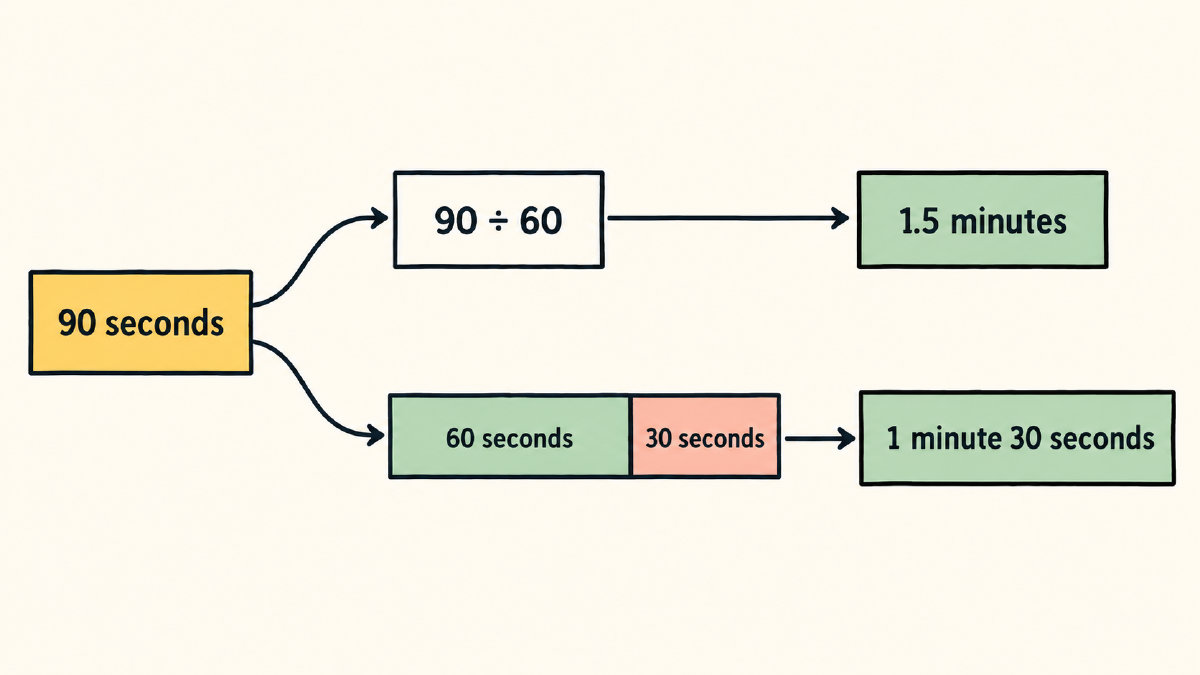
Although the decimal point is useful when representing fractions of a minute, it’s easy to misinterpret those digits as seconds. Instead, it’s better to use a colon to separate the minutes and seconds values. As an example, if you have a decimal value of 1.3 minutes, you know that there are one full minute, and that 0.3 of a minute is left. You multiply this fraction of a minute by 60 seconds to find that 0.3 minutes is equivalent to 18 seconds. Therefore, 1.3 minutes is equal to 1 minute and 18 seconds, or 1:18 (minutes:seconds). It’s important to note that 1.3 minutes is not equal to 1 minute and 30 seconds.
Repeating Decimals and Rounding Error
You might encounter situations in which the decimal representation of the calculation involves a repeating decimal. When this occurs, you may need to round the result. If you convert 100 seconds into minutes, the answer is 1⅔ minutes. Rounded to two decimal places, this is 1.67 minutes. While the exact conversion is one minute and 40 seconds, rounding changes the approximate nature of the final calculation. If you convert back from 1.67 minutes to seconds, the result will be approximately 100.2 seconds, but it should be rounded back to the original value of 100 seconds. This return to 100 seconds recovers the original duration; it isn’t required by the conversion. The difference in 1.67 × 60 = 100.2 seconds is rounding error. You can check the exact duration with 1 × 60 + 40 = 100 seconds.